Kode Company
Logistics & Supply ChainCargo & Container Operations

GAC-Cargo

Large-Scale Cargo & Container Management Platform

Internal enterprise freight system orchestrating warehouse-to-warehouse large cargo via truck and ship, enforcing dual-approval security gates for sensitive containers, per-container condition audits, and offline mobile scanning.

Client
In-House (Enterprise Product)
Industry
Logistics / Freight / Warehousing
Domain
Cargo & Container Operations
Regions
UAE & UK
Ecosystem
Paired with GAC-Rolt Documentation
Kode Company branding — Build. Solve. Evolve. (GAC-Cargo)

Project Overview

GAC-Cargo is an internal enterprise logistics platform managing large-scale cargo across warehouse-to-warehouse corridors spanning road transport and ocean freight across UAE and UK customs contexts. It works within a shared logistics ecosystem alongside GAC-Rolt for trade document automation.

Beyond standard booking and dispatch, the platform enforces a strict security distinction between common containers and high-value/sensitive secure containers—requiring physical tamper-evident seal verification, separation-of-duties dual approvals at every handover, and granular per-container tracking of intact versus damaged items.

Business Challenges

Declared shipment quantities and weights mismatched physical intake at docks

Lack of structured document-to-physical validation prior to container assignment.

Uncontrolled handling of sensitive cargo and unclear damage liability

Absence of tiered security approval matrices and checkpoint photo evidence at handovers.

Fragmented visibility across trucking legs, port transshipments, and warehouse yards

Manual spreadsheet dispatch and disconnected carrier milestones obscured live container locations and contents.

Solution & Engineering Approach

Coordinates Angular operations consoles and offline-tolerant Android Kotlin field scanners atop NestJS microservices, PostgreSQL/PostGIS geospatial storage, Kafka event pipelines, and an enforced dual-authority security workflow.

End-to-End Platform Workflow

  1. 1Multi-Leg Shipment Booking & Document Cross-Check
  2. 2Intake Weight/Quantity & Restricted-Goods Validation
  3. 3Common vs Secure Container Assignment & Sealing
  4. 4Checkpoint Condition Capture & Multi-Modal Dispatch
  5. 5Dual-Party Truck-to-Ship Handover & Tracking
  6. 6Destination Unsealing, Intact/Damaged Audit & Closure

Key Capabilities & Functional Modules

Cargo Intake & Restricted-Goods Validation

  • Captures declared dimensions, weight, cargo category (perishable, high-value, hazardous), and linked customs/packing paperwork before loading.
  • Validates physical counts and weights against container payload ceilings, flagging discrepancies (`PASSED_WITH_DISCREPANCY`) and blocking overweight dispatches unless formally overridden with an audit log.

Common vs Secure Container Authority Matrix

  • Manages ISO 6346 container lifecycles (`AVAILABLE -> ASSIGNED -> LOADING -> SEALED -> IN_TRANSIT -> UNSEALED`) across dry, reefer, open-top, and tank equipment.
  • Enforces separation of duties for Secure Containers: every loading start, tamper-evident seal application, dispatch release, route alteration, seal break, and final release demands distinct Security Officer plus Level 1 or Level 2 approvers.
  • Logs broken or mismatched seals immediately as security incidents, placing shipments on hold until senior authorization intervenes.

Per-Container Condition Inventory & Mobile Scanning

  • Tracks SKU/batch quantities inside every container across four explicit totals (expected, received, intact, damaged/missing) with photo evidence and liability attribution at each checkpoint.
  • Native Android Kotlin field client enables barcode, QR, and RFID scanning with offline buffering for low-connectivity dockyards.

Multi-Leg Dispatch, Geospatial Tracking & Ecosystem Sync

  • Schedules single or multi-leg routes combining trucks and ocean vessels, supporting container consolidation, shipment splits, and truck breakdown reassignments.
  • Processes real-time Kafka telemetry events with PostGIS and Google Maps views, ETA recalculations, customs hold pauses, and document links to GAC-Rolt.

User Roles & Operational Responsibilities

Customer / Shipper

Submits multi-leg shipment bookings and monitors verified milestone tracking and linked documents.

Warehouse Operator & Driver / Vessel Contact

Inspects incoming freight, loads containers, logs seal/damage photos via mobile scanning, and confirms custody handovers.

Dispatcher

Plans container consolidation, assigns vehicles/vessels, coordinates transshipments, and requests route changes.

Security Officer & L1/L2 Approvers

Inspects tamper-evident seals and executes multi-party authorizations across every secure container milestone.

Admin & Auditor

Governs approval delegation/escalation matrices, master data, exception queues, and immutable historical compliance reports.

Architecture Rules & Edge-Case Resilience

  • Separation-of-duties checks block any operator or approver from signing off on their own container action, while time-limited delegations handle approver unavailability cleanly.
  • GPS tracking gaps or extended secure-container silence raise immediate telemetry alerts while preserving last known geospatial coordinates.
  • Immutable inventory history logs adjustment entries as additive audit records rather than overwriting prior warehouse counts.

Confirmed Technology Stack

Web & Mobile Field Apps

  • Angular (Operations Web Console)
  • Android Kotlin (Barcode, QR & RFID Field Scanning)

Backend & Event Streaming

  • Node.js
  • NestJS
  • Microservices
  • Apache Kafka

Databases & Geospatial

  • PostgreSQL
  • PostGIS
  • MongoDB
  • Redis

Cloud, Maps & Alerts

  • Microsoft Azure
  • AWS S3 (Evidence & Photos)
  • Google Maps
  • Push Notifications / WhatsApp

Supporting Wireframes & Diagrams

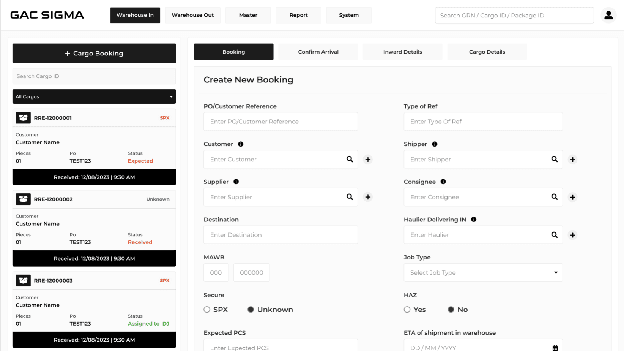
Cargo Intake & Booking Workflow Wireframe

Specification Wireframe
Specification wireframe showing the GAC-Cargo warehouse intake booking layout, cargo sidebar list, and shipment arrival status fields
Supporting specification wireframe illustrating planned inbound booking fields, shipper/consignee selectors, and clearance states from the project specification (reference wireframe, not a production screenshot).

Intended Enterprise Logistics Impact

Intended architectural and operational benefits based on system design goals

  • Verifies physical cargo weight, quantity, and compliance before freight leaves the origin yard.
  • Enforces accountable multi-party security governance across high-value and sensitive container movements.
  • Pinpoints intact versus damaged inventory per container at every handover with timestamped evidence for claims resolution.
  • Consolidates truck, ship, and warehouse yard telemetry under one auditable operational system.

Have a similar project in mind?

Schedule an architectural review or scoping discussion with Kode Company's engineering team.

Agile Development Cycles
Full Code Ownership
Dedicated Kerala & Global Engineers